There is something seriously wrong with a system when a father can tell a government department that he is becoming unable to cope, provide evidence that his income has collapsed, and still spend tens of hours trying to get someone to deal with his case properly.
That has been my experience of the Child Maintenance Service. My income has fallen by more than 70%. I have sent proof multiple times, including my HMRC tax return. I have explained my health, my financial position and the fact that I simply cannot sustain the demands being made of me. Yet the dispute continues, and I am exhausted.
I want to support my children. I also need the amount demanded to reflect my actual financial circumstances. That should be a basic expectation of any service with this much influence over people’s lives.
My life had already fallen apart
My wife and I had been married for about a year when she obtained a non-molestation order against me. In the separation that followed, I lost the ability to live in my own home and lost contact with my children. My wife and children remained in the house while I was excluded from it.
I then suffered a full mental breakdown. Chronic anxiety and panic disorder affected my ability to function and left me unable to work as I had before. My income fell dramatically, but I was still paying the mortgage and bills for a house I could not return to, alongside substantial child maintenance payments.
The financial demands did not ease simply because I became ill. I was trying to deal with the loss of my family life, the loss of my home as somewhere I could live, and the loss of my ability to earn, all at the same time.
CMS became another source of pressure when I desperately needed somebody to examine the evidence and give me a clear answer. In my experience, the repeated failures to resolve this have contributed to me feeling suicidal. I am saying that because the human consequences need to be understood.
The demands continued while I asked for help
My account shows a previous scheduled payment of £1,750 for 15 August 2026 and a next scheduled payment of £1,470.40 for 15 September. Those are the figures displayed on the dashboard. They are substantial sums to find alongside a mortgage and household bills after a collapse in income.
Based on my understanding of my reduced income, I believe I have been paying more than double the appropriate amount. That remains my disputed assessment, rather than a corrected figure CMS has formally accepted.
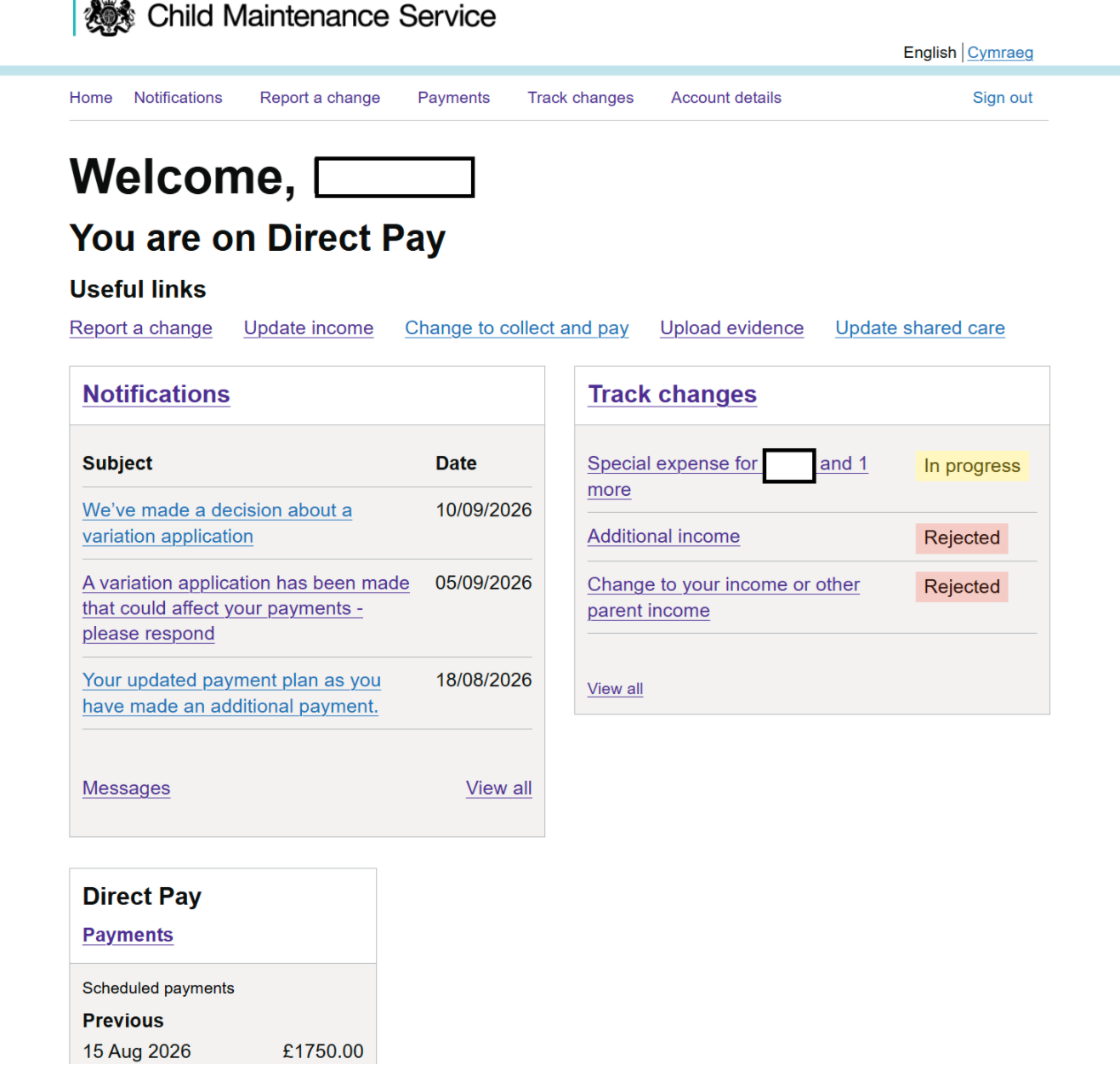
The income figures at the centre of the dispute
The calculation on my account shows regular maintenance of £392 a week, excluding arrears, effective from 23 December 2025. The first income section lists yearly gross income of £12,570. Read on its own, that screen does not explain how CMS arrived at the weekly demand.
The explanation continues on the next screen, where CMS adds a much larger amount of other income. Both parts need to be shown to understand what I am challenging.
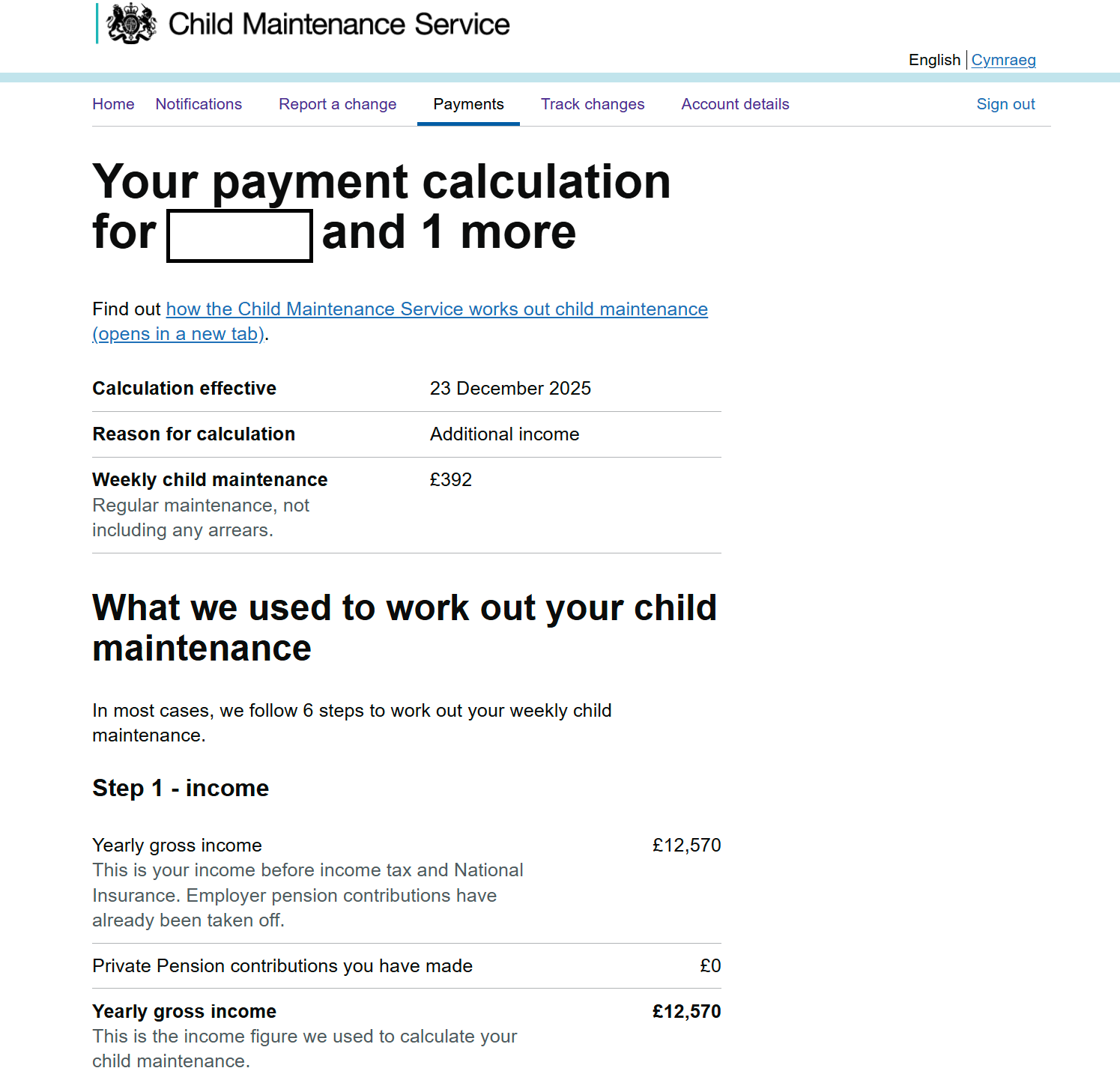
The additional income I am asking CMS to review
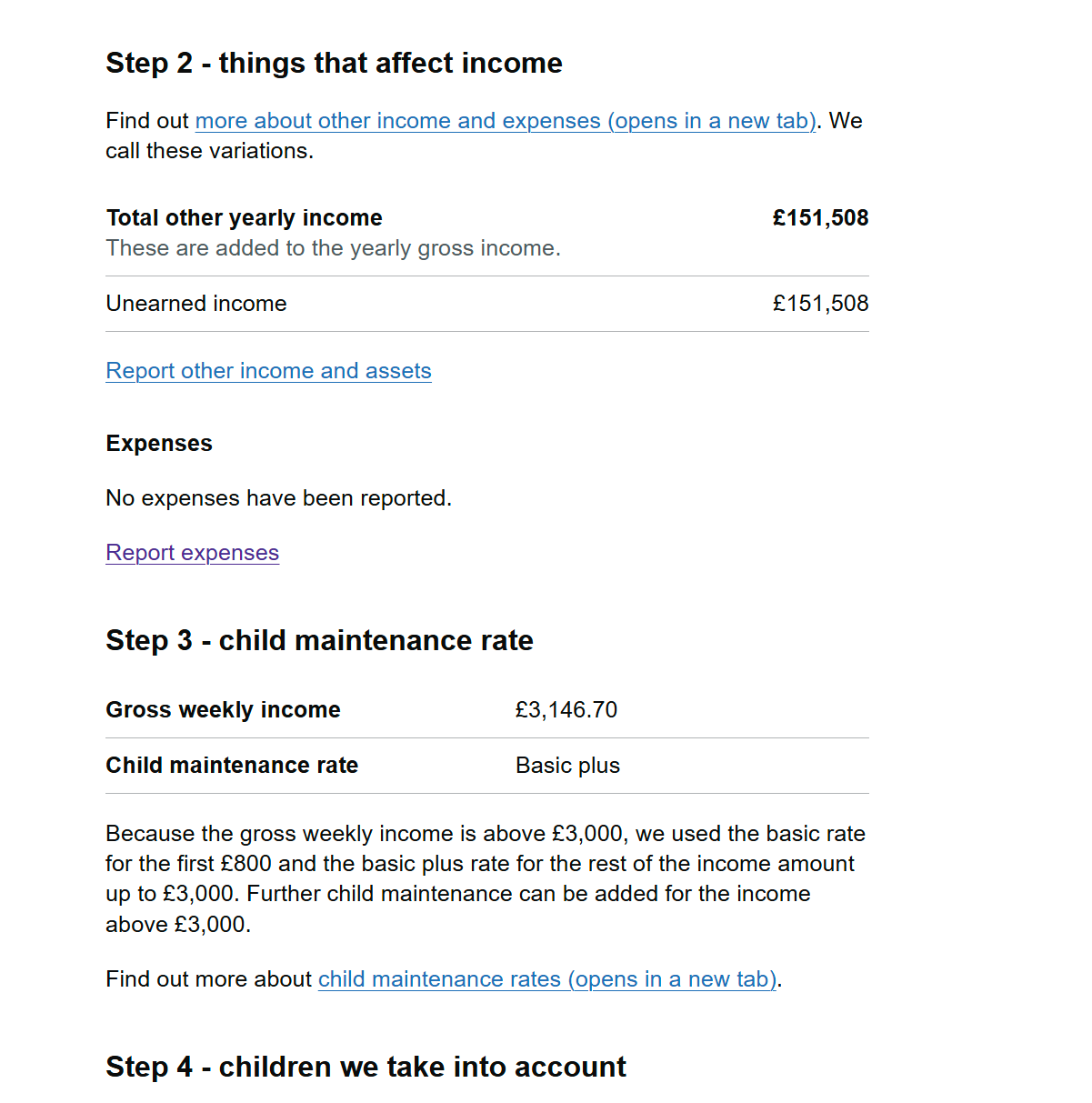
The two annual income figures displayed total £164,078. That is why showing only the £12,570 salary would give an incomplete picture. My complaint is that the income being used does not reflect the financial position I have repeatedly asked CMS to recognise.
I provided my HMRC tax return because I expected documentary evidence to be examined properly. If CMS considers that evidence insufficient, relates it to a different period, or needs something further to revise the additional-income figure, it should explain exactly what is missing and why. I should be able to understand the decision without ringing again and again.
The House of Commons Library explains that CMS commonly uses historical HMRC income information, and its June 2025 briefing describes a 25% threshold for changes in income. A tax return does not automatically settle every question about current income or an unearned-income variation. But that makes a clear explanation of the evidence and applicable rules even more necessary.
Source: House of Commons Library, paying parent income briefing, 25 June 2025
A portal can record a request without resolving it
The tracking page shows an income-change request submitted on 5 March 2026 and marked rejected on 1 April. A separate special-expense request, submitted on 21 August, is still in progress on the screenshot, with evidence uploaded and an update dated 11 September.
The account records activity. What I need is a resolution I can understand, based on the evidence I have supplied. I cannot pay bills with a status update.
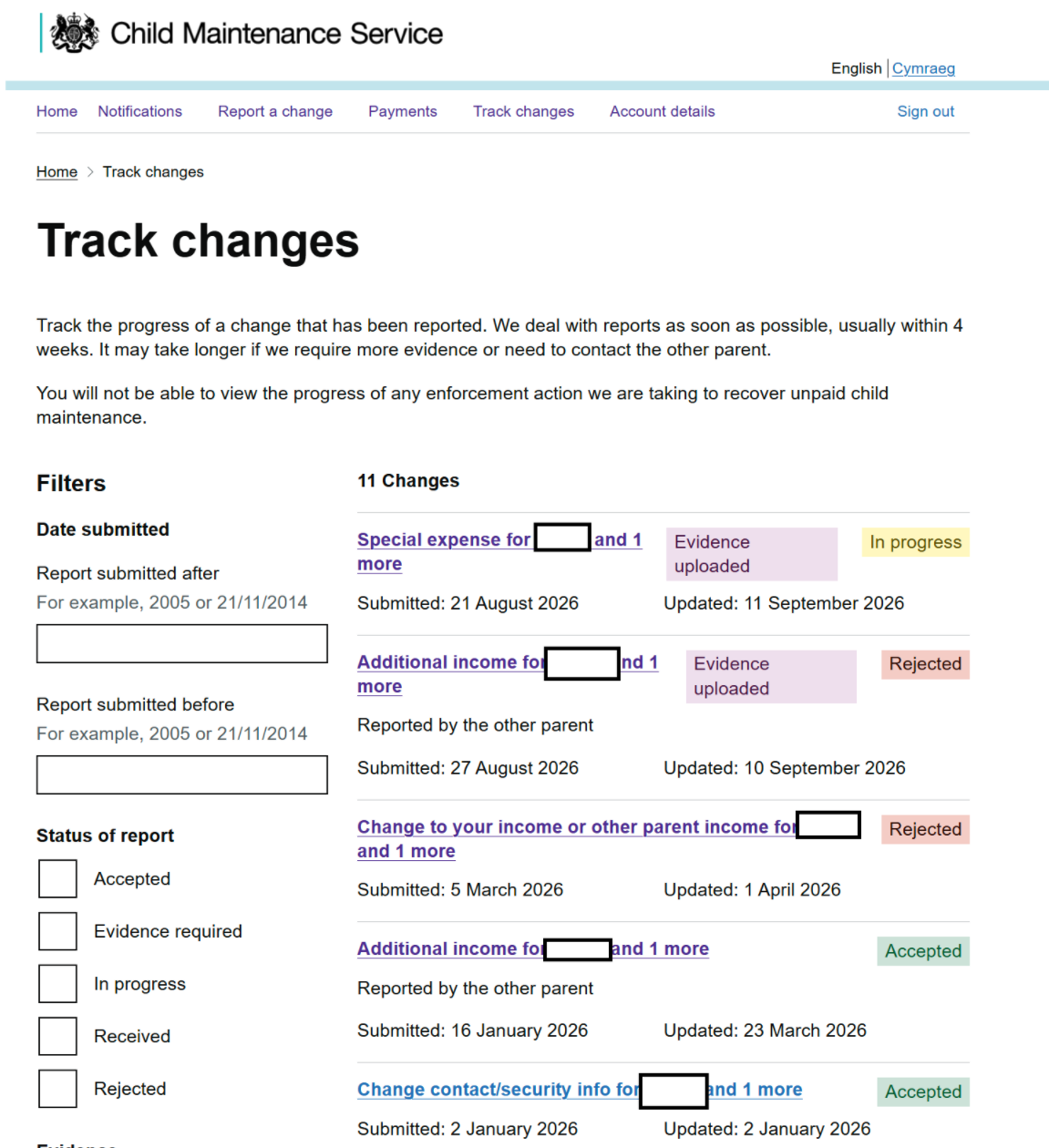
Sixteen calls and promises that led nowhere
I have rung CMS 16 times and spent tens of hours trying to get help and answers. I have had calls hung up on. On one recorded call, an agent acknowledged that my case had not been handled properly. I was promised help, but the help I was expecting never materialised.
What else am I supposed to do? I have provided evidence, explained my circumstances and kept chasing. Every further call uses time and energy I am already struggling to find. When you are seriously unwell, repeatedly having to explain why you cannot afford a demand becomes an ordeal in itself.
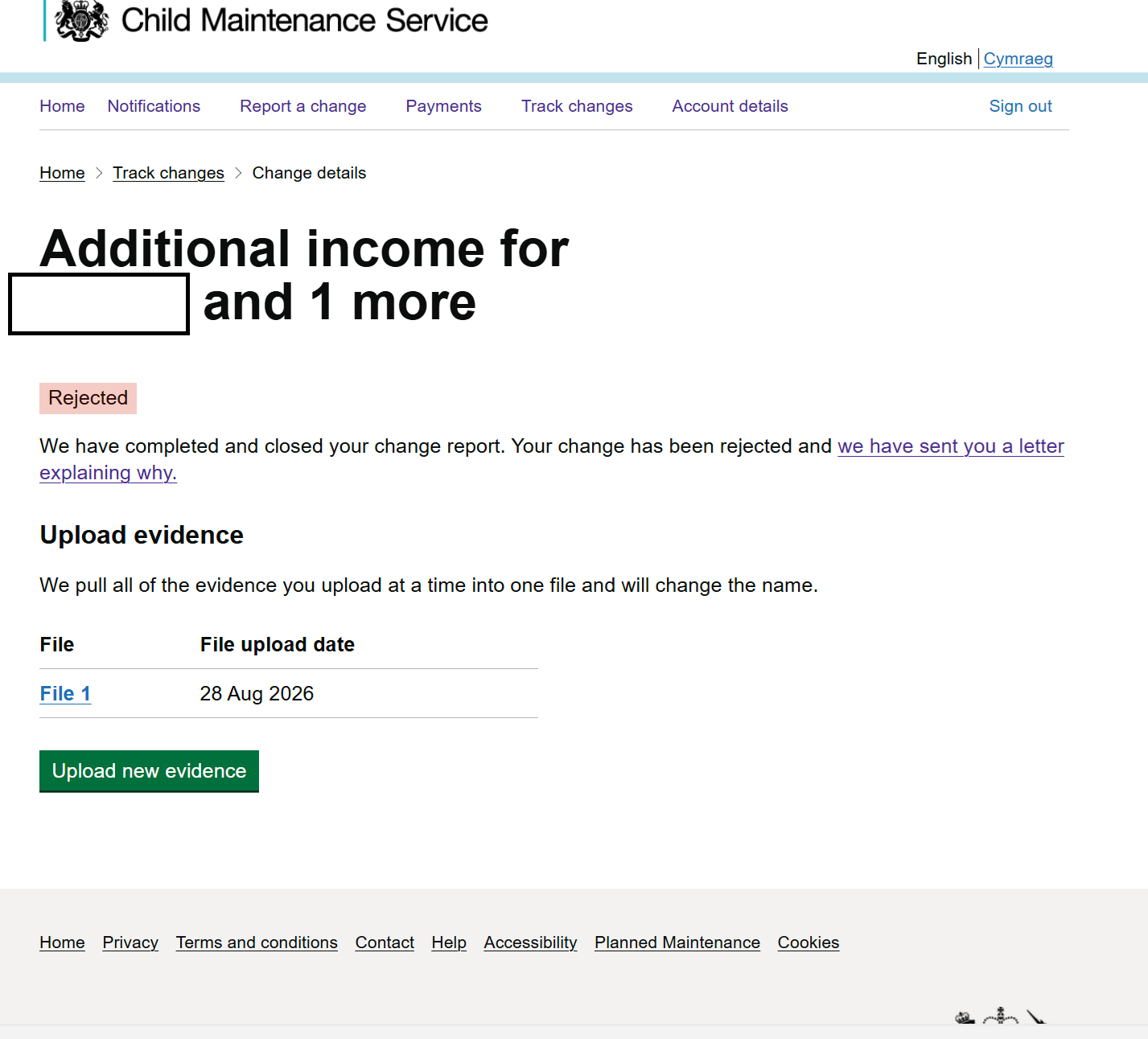
Getting a decision reconsidered has also felt painfully difficult. The government’s own guidance separates service complaints from mandatory reconsideration and then a tribunal appeal. It tells parents to request reconsideration within 30 days of the decision letter, and directs them to download and send an SSCS2 form if they subsequently appeal.
The online upload facility exists, as my screenshots show. But the wider process still involves letters, forms, different routes and waiting. A right to challenge a decision is much less useful when an ill parent struggles to navigate the process and cannot get the underlying issue resolved.
Source: GOV.UK, Child Maintenance Service complaints and appeals
Other parents describe the same frustration
I am not alone in questioning the way CMS handles disputed demands. The Times has reported an investigation identifying more than 24,000 cases in which parents had allegedly been overcharged. That is a reported allegation, rather than a finding about my case, but it raises serious questions about accuracy and how errors are corrected.
Source: The Times, investigation into allegedly incorrect maintenance demands
There are also accounts on Reddit that describe familiar frustration. These are anonymous, unverified personal accounts, not findings by a court or an investigator, and they cannot tell us how common a problem is. They do show what some people say it feels like to deal with the service.
One commenter, posting as Meredith_Primvale, described an alleged income-record error:
“I was pursued by the CMS for several years, HMRC made an oops on my tax code one year making it look like I was earning twice my income, but rectified it a month later.”
The commenter alleged that CMS continued using an incorrect payslip and described severe financial distress. Their account cannot establish what happened without the records, but the concern about getting an income figure corrected is directly relevant to mine.
Direct Reddit excerpt: Meredith_Primvale, r/unitedkingdom
Another commenter, i_am_soulless, described the difficulty of getting a consistent answer:
“Every person you speak to will tell you something different and you’ll just get random letters saying different things too.”
Direct Reddit excerpt: i_am_soulless, reply in the same discussion
A further commenter, Zaruz, wrote:
“No one will speak up for the paying parents though, as they will assume deadbeat dads who just don’t want to pay.”
Zaruz described past financial hardship and referred to the CSA, the predecessor agency, so that experience should not be presented as a verified current CMS case. The fear of being dismissed simply for questioning a payment is nevertheless one I recognise.
Direct Reddit excerpt: Zaruz, r/unitedkingdom
The same discussion includes receiving parents describing unpaid maintenance. Children need financial support, and parents should meet their responsibilities. A competent service must be able to pursue deliberate non-payment while also correcting demands when the evidence supports a change. Those duties belong together.
The effect on my mental health needs to be taken seriously
I was already struggling with anxiety, panic and the breakdown of my family life. The repeated demands, rejected requests and exhausting attempts to get answers added to that pressure. I have felt depressed, overwhelmed and suicidal. CMS needs to understand what it means when a parent tells them this.
National statistics provide important context. The House of Commons Library reports 7,147 registered suicide deaths across the UK in 2024. In England and Wales, the age-standardised rate was 17.6 deaths per 100,000 men, compared with 5.7 per 100,000 women. The male rate was roughly three times the female rate.
Those figures do not tell us how many deaths involved CMS, and they do not establish that a record number of men have died because of maintenance disputes. I cannot honestly turn national suicide statistics into a CMS death toll. What I can describe is the effect this process has had on me, and why a service dealing with distressed parents needs to respond before their health deteriorates further.
Source: House of Commons Library, Suicide statistics, 8 January 2026
CMS needs to take responsibility for resolving cases
In my experience, CMS has been incompetent in its handling of my case. I have supplied evidence repeatedly, made 16 calls and been promised help without receiving the resolution I need. I do not consider that fit for purpose.
I want someone to take ownership of my case, review the income evidence and explain the calculation in plain English. That explanation needs to identify the period and source of each income figure, what CMS has accepted or rejected, and what further evidence it requires. If the calculation is wrong, I want it corrected and the consequences of the error addressed.
The mortgage and bills matter because they are part of the financial pressure I have been describing. I am not claiming that paying them automatically cancels or reduces maintenance. I am asking CMS to deal properly with any relevant expense application and explain the outcome, rather than leave me trying to reconcile contradictory-looking screens and unresolved requests.
A parent who reports serious mental distress should also receive a prompt, coordinated response. Acknowledging that a case has been mishandled is only useful if somebody then acts on it. A promise of help needs an owner and a realistic date for the next decision.
I want to recover, work and support my children on a sustainable basis. I need CMS to examine the evidence, communicate clearly and stop leaving me to carry the cost of an unresolved dispute. After everything I have supplied and every call I have made, that is a reasonable demand.
If this article reflects how you are feeling, Samaritans can be reached free on 116 123 in the UK and Ireland. If you are in immediate danger, call 999.
Sources
Every factual claim above traces back to one of these documents. If a link has died or a document has since been amended, tell us and we will update the piece.
- 01Paying parent income briefing, 25 June 2025House of Commons Library
- 02Child Maintenance Service: complaints and appealsGOV.UK
- 03Investigation into allegedly incorrect maintenance demandsThe Times
- 04Suicide statistics, 8 January 2026House of Commons Library
The Desk
Site administrator. Runs the CMS, signs off publication and maintains the corrections log.
More from this deskHave we got something wrong? We publish corrections in full and dated on the article itself rather than quietly amending it. Send us the document through the contact page.